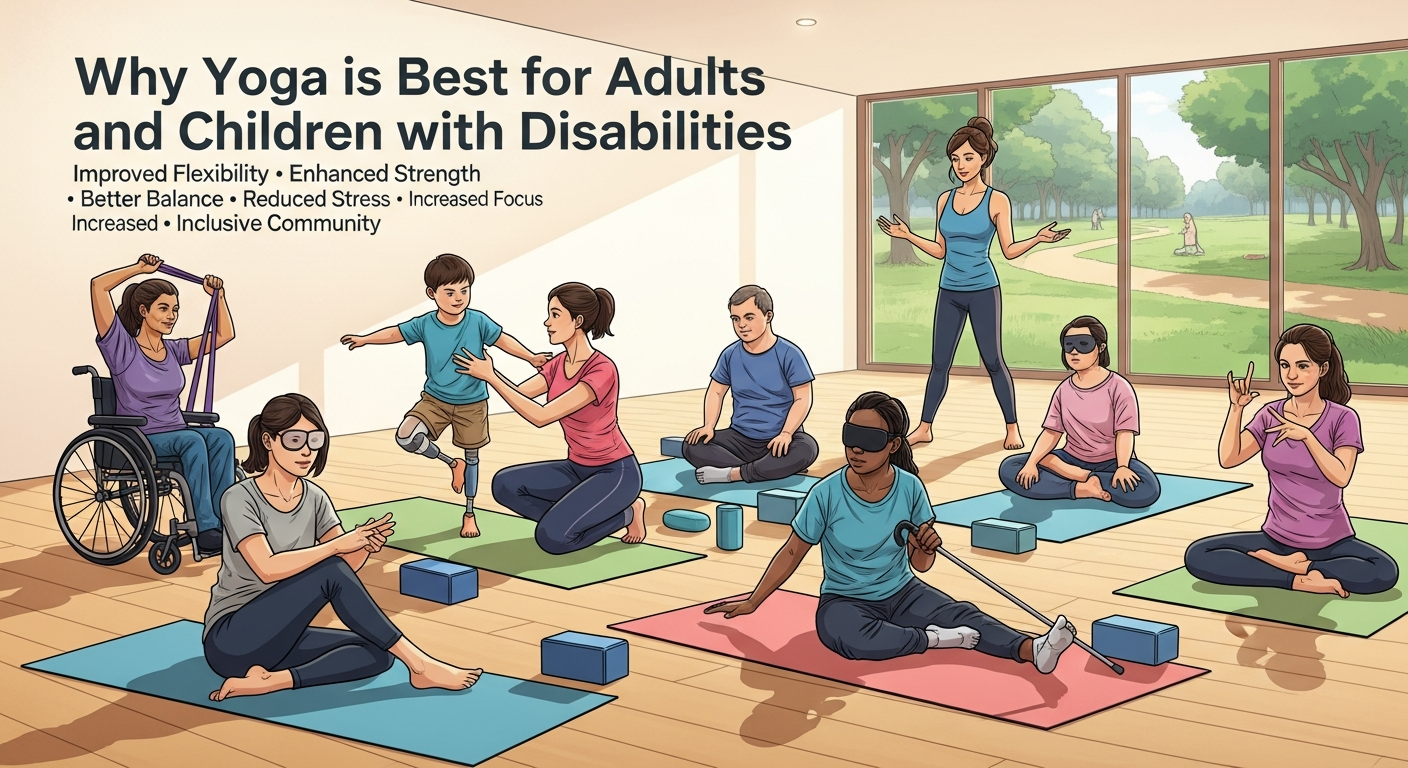
According to a recent CDC report, more than 1 in 6 adults in the USA practice yoga. A new survey has been published by the Centers for Disease Control and Prevention. More than 80% of adults and children have been practicing improving their health. About 30% of them are used to manage pain. Adults and Children with Disabilities in the US have been offered yoga practice sessions to improve their health.
Yoga for people with disabilities:
Yoga is the ancient Indian practice that involves moving the body while training the mind. These are the best ways to achieve well-being and balance for adults and children with Disabilities. The main purpose of practicing yoga & physical fitness training in New Jersey is to be healthy, both physically and mentally. Some of the most important components of Yoga are
1. Pranayama or Breathwork
Pranayama involves proper breathing techniques. These are body processes controlled by the autonomic nervous system. Many people also find these when they are anxious. Breath becomes much shallower and quicker. The Pranayama process helps to slow the breath down and breathe more deeply. These have a calming effect on the person.
2. Belly Breathing
Belly Breathing exercise helps to breathe in and out through the nose efficiently. Gently push your belly out as you inhale. These are automatically helpful for expanding the diaphragm in the best manner.
You need to exhale while pulling the belly in at the end of exhalation. Exhaling would push the air out to the lower portion of the lungs. These are the best ways to remove toxins from the air that the lungs inhale.
3. Dhyana
Dhyana, also called meditation, involves a state of extreme relaxation along with concentration of the body. These help the mind to surface thoughts. Dhyana helps to improve self-realization by having a clear vision of the world. These are the best options for adults and children with Disabilities to gain peace of mind.
4. Asanas
Asanas are physical postures practiced in Yoga. The asanas are gentle with the non-strenuous stretches in limbs. Physical Postures will be extensively coordinated with breath. These also allow blood to circulate and vitalize the internal organs.
There are varied asanas available which can be modeled after movements. Asanas focus on moving joints throughout the full range of motion, extensively lengthening muscles. Asanas can be learned over time with regular practice.
Benefits of Yoga for adults and children with Disabilities
A recent survey also found that women in the US are more likely than men to practice yoga. More than 23% of U.S. women practice yoga. The Yoga & Physical training sessions are also given for adults and children with disabilities.
These are popular options among people who have disabilities. The U.S. has gained popularity over the past 20 years for providing these sessions for children.
Below are some of the benefits of practicing Yoga for adults and children with disabilities
1. Improved Physical Health
Yoga can be much more helpful for managing chronic pain. These can ultimately reduce tension and stress in the body. Yoga is also the best way to assist lung function. These can automatically improve the breathing for adults and children with respiratory issues. These extensively focus on controlling the breath during the exercises.
2. Improved Mental Health
Yoga techniques help children with disabilities become aware of their emotions and thoughts. These can be extensive, leading to better emotional control. These are also proven to reduce stress along with anxiety.
These would be suitable for activating the parasympathetic nervous system. It is also suitable for lowering cortisol levels. Yoga would foster positive connections with the body. It will be suitable for helping those with complex relationships with physical abilities.
3. Digestive system
Bending and stretching poses in Yoga help to stimulate the digestive system. These can be seen as common ways to improve health conditions. It also reduces the feeling of stress. Stretching poses make the internal organs work properly.
4. Cardiovascular systems
Various types of yoga can be practiced, starting from aerobic exercise. These easily increase the heart rate in the best way.
5. Lymphatic system
The lymphatic system is a primary component of our body’s immune system. The lymphatic system lacks a pump compared to the blood system. These would rely on the muscles during body movements to improve circulation.
Adults and children with disabilities can improve their Physical activity and stretching with the yoga asanas. These would automatically strengthen the Lymphatic system. Regular practice of pranayama would also stimulate the lungs’ function.
Conclusion
Yoga & Physical training can be a great way to improve the health condition of adults and children with disabilities. These involve gentle movement and body awareness, so it works on overall strength and balance. Yoga can deliver significant benefits for those with mobility challenges. Yoga’s increasing popularity in the United States can help people learn its philosophy and practice different types of yoga.
FAQ
1. Do Adults and Children with Disabilities Need to Be Flexible to Do Yoga?
No! Yoga does not need flexibility. Yoga practices have limited mobility, so it will be easier to work within the range of motion.
2. Does a person with disabilities Need Prior Yoga Experience?
No experience is necessary for doing Yoga exercises. These yoga classes are best for everyone, regardless of age and ability. The person can be a beginner or have tried yoga before. These yoga sessions are tailored to meet your needs in a supportive environment.
3. Can a person practice yoga with an injury?
Consulting a healthcare professional is important before starting Yoga if you have an injury. It is best to inform the instructor of the injury so they can provide the necessary modifications. It would automatically ensure safe practice. These sessions can be a great option for those recovering from injuries.
4. How often should a person practice yoga?
Practicing Yoga a few times a week will be completely ideal. These can provide significant benefits. Consistent yoga practice is the best way to improve strength and flexibility. Practicing yoga for chronic illness sessions can help you feel stronger.
5. Can yoga help reduce anxiety in patients?
Yes! Recent Studies show yoga reduces anxiety through breath control. These easily decrease the mindfulness during the gentle movement with breath work.
I went over this site and I conceive you have a lot of fantastic information, bookmarked (:.
Бесплатная консультация инженера в Борисове. Выезд, осмотр фасада, оценка объема, ответы на вопросы. Никакого навязывания. Поможем принять взвешенное решение. Запишитесь на удобное время через сайт или по телефону. Будем рады помочь! купить сайдинг Борисов
Исправление ошибок прошлых лет в 1С Бухгалтерия выполняется через отдельные документы. Если ошибка существенна и период утвержден, корректировки вносятся на счет 84. В текущем году делается запись прошлых лет. Подача уточненной налоговой декларации обязательна. Программа не позволяет механически сторнировать старые документы после закрытия года. buhgalteriya0.wordpress.com
Квартира-музей. Винтаж, пластинки, диапроектор. Раритетная мебель 60-х. Фотоаппарат «Зенит» как декор. Ностальгия по СССР. Молодым будет интересно, пожилым — знакомо. Необычный формат. Квартира на сутки со смыслом. Экскурс в прошлое. квартира на сутки молодечно
I intended to compose you one little word to thank you so much again for all the great views you’ve shown on this site. This has been really unbelievably generous with you to give openly all that a number of people would have distributed as an e-book to end up making some dough for their own end, most importantly given that you might well have tried it if you decided. The pointers also worked like a great way to recognize that other people have similar desire like my personal own to grasp many more when it comes to this problem. I think there are a lot more fun instances ahead for individuals who looked over your blog.
Incredible! This blog looks just like my old one! It’s on a completely different subject but it has pretty much the same layout and design. Excellent choice of colors!
I truly appreciate your work, Great post.
Hi, Neat post. There is a problem with your website in internet explorer, would check this… IE still is the market leader and a huge portion of people will miss your excellent writing because of this problem.
WONDERFUL Post.thanks for share..extra wait .. …
Thanks for sharing excellent informations. Your site is very cool. I’m impressed by the details that you’ve on this website. It reveals how nicely you perceive this subject. Bookmarked this website page, will come back for extra articles. You, my pal, ROCK! I found simply the info I already searched all over the place and just couldn’t come across. What a perfect website.
Currently it seems like WordPress is the preferred blogging platform out there right now. (from what I’ve read) Is that what you’re using on your blog?
It is the best time to make some plans for the future and it is time to be happy. I have read this post and if I could I want to suggest you some interesting things or advice. Maybe you could write next articles referring to this article. I want to read more things about it!
I always was concerned in this topic and still am, thanks for posting.
I always was interested in this subject and stock still am, thanks for putting up.
Undeniably consider that which you stated. Your favorite reason appeared to be on the web the easiest thing to understand of. I say to you, I certainly get irked whilst other folks think about worries that they plainly don’t realize about. You managed to hit the nail upon the highest and defined out the whole thing without having side effect , people could take a signal. Will likely be back to get more. Thank you
Fascinating blog! Is your theme custom made or did you download it from somewhere? A design like yours with a few simple tweeks would really make my blog stand out. Please let me know where you got your theme. Kudos
Pretty! This was a really wonderful post. Thank you for your provided information.
Lovely website! I am loving it!! Will come back again. I am bookmarking your feeds also.
I like what you guys are up too. Such intelligent work and reporting! Keep up the superb works guys I have incorporated you guys to my blogroll. I think it will improve the value of my site :).
You got a very wonderful website, Glad I observed it through yahoo.
wonderful points altogether, you just gained a brand new reader. What would you suggest about your post that you made a few days ago? Any positive?
Thank you for another informative blog. Where else may just I am getting that type of info written in such a perfect approach? I have a challenge that I’m just now working on, and I have been on the look out for such info.
Does your website have a contact page? I’m having trouble locating it but, I’d like to shoot you an e-mail. I’ve got some recommendations for your blog you might be interested in hearing. Either way, great website and I look forward to seeing it expand over time.
As I website possessor I believe the content matter here is rattling wonderful , appreciate it for your hard work. You should keep it up forever! Best of luck.
Woh I love your posts, bookmarked! .
Heya! I just wanted to ask if you ever have any trouble with hackers? My last blog (wordpress) was hacked and I ended up losing a few months of hard work due to no data backup. Do you have any methods to prevent hackers?
Only a smiling visitant here to share the love (:, btw outstanding style.
I feel that is one of the most significant information for me. And i’m glad studying your article. However want to statement on few common issues, The website style is perfect, the articles is truly excellent :D. Excellent activity, cheers
Very interesting details you have mentioned, thankyou for putting up. “‘Tis an ill wind that blows no minds.” by Malaclypse the Younger.
I’ll immediately snatch your rss as I can not in finding your e-mail subscription link or e-newsletter service. Do you’ve any? Please permit me know in order that I may subscribe. Thanks.
I am impressed with this site, really I am a fan.
Some truly rattling work on behalf of the owner of this internet site, perfectly outstanding articles.
Hello there! Quick question that’s totally off topic. Do you know how to make your site mobile friendly? My website looks weird when browsing from my iphone. I’m trying to find a template or plugin that might be able to fix this issue. If you have any suggestions, please share. Thanks!
You are a very clever individual!
I wanted to thank you for this great read!! I definitely enjoying every little bit of it I have you bookmarked to check out new stuff you post…
Квартира на сутки в Сморгони с балконом и видом на городской парк. Утром так приятно выпить кофе, глядя на зелень. Внутри все новое: мебель, сантехника, техника. Плюсы: собственный паркинг и круглосуточный check-in. Из достопримечательностей рекомендуем Calvary и краеведческий музей. Природа и цивилизация в одном флаконе ждут вас аренда квартиры на сутки в Сморгони
Just wanna input on few general things, The website style and design is perfect, the subject matter is really superb. “Some for renown, on scraps of learning dote, And think they grow immortal as they quote.” by Edward Young.
I simply couldn’t leave your website prior to suggesting that I extremely loved the standard info a person supply on your guests? Is going to be back continuously to check up on new posts
Hello there, You have performed a great job. I’ll certainly digg it and personally suggest to my friends. I’m confident they will be benefited from this site.
Hi my family member! I want to say that this post is amazing, great written and come with approximately all vital infos. I would like to peer extra posts like this.
Сдаем квартиру на сутки в Лиде с современной системой очистки воды и кондиционером. Заботимся о вашем здоровье и комфорте. Вода вкусная, воздух свежий. Плюсы: фильтры для воды и климат-контроль. Достопримечательности Лиды: Лидский замок, церковь Святого Георгия и памятник воинам-интернационалистам. В квартире приятно находиться в любую погоду. Высокий уровень сервиса для тех, кто привык к лучшему. Приезжайте и оцените заботу о деталях аренда квартиры Лида
I’m really inspired along with your writing abilities as smartly as with the layout to your blog. Is that this a paid topic or did you modify it your self? Either way keep up the nice quality writing, it is uncommon to peer a nice weblog like this one today..
Квартира на сутки в Гродно — идеальный вариант для компании друзей. Это дешевле, чем несколько гостиничных номеров. После прогулки по Швейцарской долине и посещения Старого замка, вечером вы сможете собраться в просторной гостиной, обсудить увиденное и поиграть в настольные игры, чувствуя себя абсолютно свободно снять квартиру на сутки в Гродно
I’ve learn a few excellent stuff here. Certainly value bookmarking for revisiting. I wonder how so much attempt you set to make one of these fantastic informative web site.
Thanks for this post, I am a big fan of this internet site would like to proceed updated.
This is a very good tips especially to those new to blogosphere, brief and accurate information… Thanks for sharing this one. A must read article.
I’m curious to find out what blog system you are using? I’m experiencing some small security problems with my latest website and I would like to find something more safe. Do you have any suggestions?
excellent issues altogether, you simply received a brand new reader. What could you suggest about your post that you made some days in the past? Any positive?
This is very interesting, You are a very skilled blogger. I have joined your rss feed and look forward to seeking more of your magnificent post. Also, I have shared your website in my social networks!
Glad to be one of several visitants on this awing site : D.
I’m just writing to let you understand of the notable encounter our child undergone reading through your web page. She noticed many pieces, which included how it is like to have an incredible teaching character to have other people very easily thoroughly grasp specified advanced subject matter. You really exceeded our own expectations. Thanks for showing such necessary, safe, edifying and even fun tips on the topic to Kate.
I would like to thnkx for the efforts you have put in writing this blog. I am hoping the same high-grade web site post from you in the upcoming as well. Actually your creative writing abilities has inspired me to get my own website now. Really the blogging is spreading its wings fast. Your write up is a great example of it.
Hello very nice blog!! Man .. Excellent .. Wonderful .. I’ll bookmark your website and take the feeds additionally…I’m satisfied to find so many useful info right here in the post, we’d like work out extra strategies in this regard, thanks for sharing.
you’ve gotten an ideal weblog right here! would you prefer to make some invite posts on my blog?
I will immediately clutch your rss as I can’t to find your e-mail subscription hyperlink or newsletter service. Do you have any? Please allow me know so that I could subscribe. Thanks.
Howdy! This is my 1st comment here so I just wanted to give a quick shout out and tell you I really enjoy reading your posts. Can you suggest any other blogs/websites/forums that deal with the same subjects? Thanks a lot!
Hey! I simply wish to give a huge thumbs up for the great info you have got right here on this post. I will be coming back to your blog for extra soon.
It’s laborious to find educated folks on this topic, but you sound like you already know what you’re speaking about! Thanks
I’d have to examine with you here. Which is not one thing I usually do! I take pleasure in reading a post that may make folks think. Additionally, thanks for permitting me to comment!
I got what you mean , regards for putting up.Woh I am lucky to find this website through google.
I think other website proprietors should take this web site as an model, very clean and fantastic user genial style and design, let alone the content. You’re an expert in this topic!
I feel that is among the most important info for me. And i am happy studying your article. But should statement on some normal things, The web site taste is wonderful, the articles is truly great :D. Excellent job, cheers
Whoa! This blog looks exactly like my old one! It’s on a completely different topic but it has pretty much the same layout and design. Wonderful choice of colors!
I conceive you have observed some very interesting points, thankyou for the post.
This design is incredible! You definitely know how to keep a reader amused. Between your wit and your videos, I was almost moved to start my own blog (well, almost…HaHa!) Fantastic job. I really loved what you had to say, and more than that, how you presented it. Too cool!
Very interesting points you have observed, thankyou for putting up. “These days an income is something you can’t live without–or within.” by Tom Wilson.
Nice read, I just passed this onto a colleague who was doing some research on that. And he just bought me lunch as I found it for him smile Thus let me rephrase that: Thanks for lunch! “Dreams are real while they last. Can we say more of life” by Henry Havelock Ellis.
I truly appreciate your work, Great post.
Hey! I just want to give a huge thumbs up for the great information you may have here on this post. I might be coming back to your weblog for more soon.
Good day! This is kind of off topic but I need some help from an established blog. Is it tough to set up your own blog? I’m not very techincal but I can figure things out pretty fast. I’m thinking about creating my own but I’m not sure where to begin. Do you have any tips or suggestions? Appreciate it
It’s a shame you don’t have a donate button! I’d certainly donate to this brilliant blog! I suppose for now i’ll settle for book-marking and adding your RSS feed to my Google account. I look forward to brand new updates and will talk about this website with my Facebook group. Talk soon!
Would love to incessantly get updated great web site! .
After study a few of the blog posts on your website now, and I truly like your way of blogging. I bookmarked it to my bookmark website list and will be checking back soon. Pls check out my web site as well and let me know what you think.
Can I simply say what a reduction to find somebody who actually knows what theyre talking about on the internet. You positively know methods to bring a problem to light and make it important. More folks have to learn this and understand this facet of the story. I cant believe youre not more standard because you undoubtedly have the gift.
Would love to constantly get updated outstanding blog! .
I have been absent for some time, but now I remember why I used to love this site. Thank you, I will try and check back more often. How frequently you update your site?
The very crux of your writing while appearing agreeable at first, did not sit properly with me personally after some time. Somewhere within the sentences you were able to make me a believer unfortunately only for a short while. I still have got a problem with your leaps in assumptions and you might do nicely to help fill in those breaks. When you actually can accomplish that, I could certainly end up being impressed.
Enjoyed looking through this, very good stuff, appreciate it.
I really enjoy studying on this site, it has great articles. “Beware lest in your anxiety to avoid war you obtain a master.” by Demosthenes.
Somebody essentially help to make significantly articles I’d state. That is the very first time I frequented your web page and so far? I surprised with the research you made to make this actual submit incredible. Fantastic process!
I just like the valuable info you supply in your articles. I will bookmark your weblog and check again right here frequently. I am quite sure I’ll be informed many new stuff proper right here! Good luck for the following!
Very nice style and superb written content, nothing at all else we require :D.
I’m still learning from you, as I’m trying to achieve my goals. I definitely enjoy reading all that is written on your website.Keep the posts coming. I enjoyed it!
Hello. fantastic job. I did not imagine this. This is a remarkable story. Thanks!
Hey there are using WordPress for your site platform? I’m new to the blog world but I’m trying to get started and create my own. Do you need any coding knowledge to make your own blog? Any help would be really appreciated!
Woh I like your blog posts, saved to favorites! .
It’s actually a cool and helpful piece of information. I am glad that you shared this helpful info with us. Please keep us informed like this. Thanks for sharing.
This design is steller! You definitely know how to keep a reader entertained. Between your wit and your videos, I was almost moved to start my own blog (well, almost…HaHa!) Wonderful job. I really loved what you had to say, and more than that, how you presented it. Too cool!