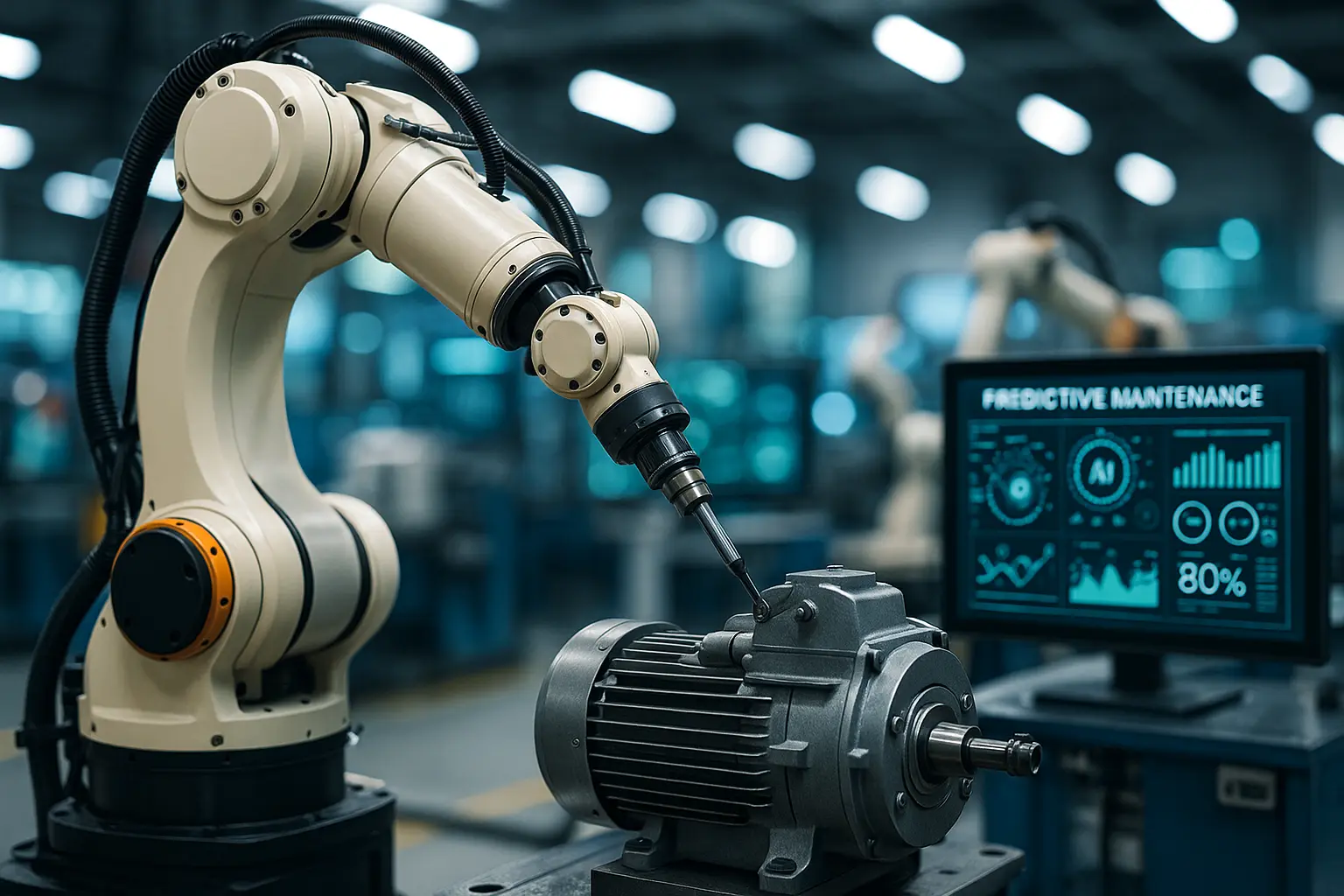
Machines never fail when they are needed the most does it? One minute, all is going on and the following minute, your whole line is stalled. That is what the manufacturers all over the world are resorting to in order to use AI-based Predictive Maintenance. Consult Hidden Brains, for custom software development for the manufacturing industry with AI-driven maintenance expertise are in high demand.
And here’s the big sign that the shift is real. Nearly 60% of leading US automotive manufacturers now use AI tools—including PdM—to keep their assembly lines and equipment running without surprises. The trend is growing fast because it works.
In reality, North America has taken the first position in the world market of AI-in-manufacturing with almost 40% of its share in 2024 due to high investments in the field of R&D. If you want to know how it ensures operational efficiency in manufacturing, this article is for you.
What Exactly Is AI-powered Predictive Maintenance?
Let’s keep this simple. Predictive Maintenance, or PdM, is just a smarter way to take care of your machines. Instead of waiting, manufacturing software development services deploy AI to watch how your equipment behaves every day.
It reads patterns from machine data—things like vibration, temperature, or unusual sounds. Sensors and IoT devices collect these tiny signals in real time. AI then looks for anything that feels “off.”
Think of it as your machine whispering, “Something’s not right. Fix me soon.”
In other words, AI tells you what will break… before it actually breaks.
No guesswork. No surprise failures. Just clear, early warnings that help you stay in control.
Why Traditional Maintenance Isn’t Enough Anymore
Let’s be honest. The old way of maintaining machines feels a lot like guesswork. You fix things when they break. Or you fix things on a fixed schedule—whether they actually need it or not. Well, at any rate, you waste time, money and a great deal of team energy. And in the modern hectic manufacturing industry, that does not suffice anymore.
Reactive Maintenance: Always One Step Too Late
Waiting for a breakdown sounds simple, but it’s costly. Every sudden stop hurts production. Across US manufacturing, unplanned downtime has been cut by up to 30% in plants that switched to AI-powered PdM. That tells you how much reactive maintenance was holding them back.
Preventive Maintenance: Still a Guessing Game
Prevention schedules are a bit safer, although they are also based on assumptions. You shut down machines even when nothing’s wrong. You replace parts that may still have life left. This leads to wasted effort—and wasted money. AI PdM, on the other hand, helps companies reduce overall maintenance costs by up to 25% because it knows exactly when something needs attention.
Predictive Maintenance: Finally, a Smarter Way
This is where everything changes. PdM uses real-time insights instead of rough estimates. No more guessing. No more unnecessary checks. In fact, 29.7% of all AI deployments in manufacturing are now focused on machinery maintenance because the impact is that big.
Look at Georgia-Pacific in the US. They’re using AI tools to monitor equipment health and alert operators instantly. The result? Hundreds of millions in annual value captured. And it all started by moving beyond traditional maintenance.
How AI Actually Works in Maintenance
AI in maintenance isn’t magic. It’s just a smarter way of listening to your machines. Your equipment is constantly sending signals—you just couldn’t hear them before. AI helps you finally tune in.
It Starts With Simple Data
Machines produce clues all the time.
Tiny vibrations. Slight temperature changes. Odd sounds. Even downtime logs you’ve been collecting for years. These signals are sensed and transmitted to an AI system. Nothing complicated. Just everyday data you already have.
AI Spots Early Warnings
After the data is received, AI begins searching patterns. It is the comparison of what is going on now with months-or-years of past conduct. If something feels unusual, AI flags it. Maybe a motor is running hotter than normal. Maybe the vibration frequency changed. This is AI quietly whispering, “Something is off. Check this soon.”
It Predicts the Exact Failure Window
Here’s where it gets really helpful. AI doesn’t just warn you. It also estimates when the failure might happen. Not vague predictions. Actual time windows. Like your machine saying, “Hey, I’m going to fail in about 7 days if you don’t fix me.”
All This Happens in Real Time
No delays. No manual checks. No waiting for surprises. You get live insights that help you plan maintenance at the perfect moment—neither too early nor too late.
The Real Benefits You’ll Notice Immediately
The situation changes and becomes much more relaxed, smooth, and predictable when you implement AI-powered Predictive Maintenance in your factory. These are the advantages that you will immediately feel.
Zero Surprises on the Shop Floor
Unexpected breakdowns become rare. Machines stop failing out of nowhere. You finally get ahead of the problems instead of running behind them.
Lower Maintenance Costs
No more replacing parts that still work. No more emergency fixes. You spend only on what’s truly needed—and save a good chunk of your budget in the process.
Better Planning and Zero Last-Minute Panic
Maintenance becomes a scheduled activity. You choose the time. You choose the window. Production stays stable because nothing interrupts it suddenly.
Longer Machine Life
When you fix issues early, machines last longer. They don’t take the heavy hits or sudden shocks that shorten their lifespan.
Happier, More Confident Teams
Your maintenance team stops firefighting. The maintenance team prevents firefighting. They receive less number of emergency calls and more time to undertake meaningful work. And your operators are also more comfortable that they have healthy equipment.
Use Cases Across the Manufacturing Floor
However, predictive maintenance driven by AI is not limited to a single machine type. It fits flawlessly throughout the entire shop floor, reducing surprises and maintaining smooth operations. Here are some real examples of how it works in different areas.
- Production Lines
Ford uses AI-driven PdM in its US plants to monitor robotic systems. AI can anticipate failures before they stop the line thanks to sensors that track minute wear patterns. This strategy reduces unplanned downtime and maintains production without expensive pauses.
- CNC Machines
AI watches for unusual vibrations, temperature spikes, or tool wear. Instead of stopping mid-operation, CNC units send early warnings so operators can act before a breakdown hits.
- Heavy Machinery
In energy and EV manufacturing, companies like WattsUp provide real-time analytics for chargers and heavy equipment. Their PdM tools help reduce maintenance interruptions by up to 40%, extending asset life through quick anomaly detection.
- Packaging Systems
PepsiCo uses predictive algorithms and computer vision to monitor bottling lines, conveyors, and high-speed packaging units. When something starts slipping out of normal behavior, AI flags it instantly—keeping downtime low and supply chains stable.
- Robots
Robots send constant data on motors, joints, and movement patterns. AI tracks these signals and warns teams before wear turns into failure. That means fewer stoppages and faster production cycles.
Conclusion
AI-powered Predictive Maintenance isn’t just another upgrade. It’s a shift in how you run your factory. Instead of reacting to problems or guessing when to fix things, you move into a world of clarity and control. Machines warn you early. Teams stay calm. Production flows without constant interruptions. In addition, it is evident that predictive maintenance (PdM) is shaping up to be the new norm in operational efficiency as more and more manufacturers, which include food processing companies, automotive companies and electric vehicles, adopt PdM technologies. Factories that take the initiative now to implement PdM technologies will operate much more efficiently, save money, and be much farther ahead than factories that still rely heavily on antiquated practices for maintenance. Your future is already here and can be predicted.